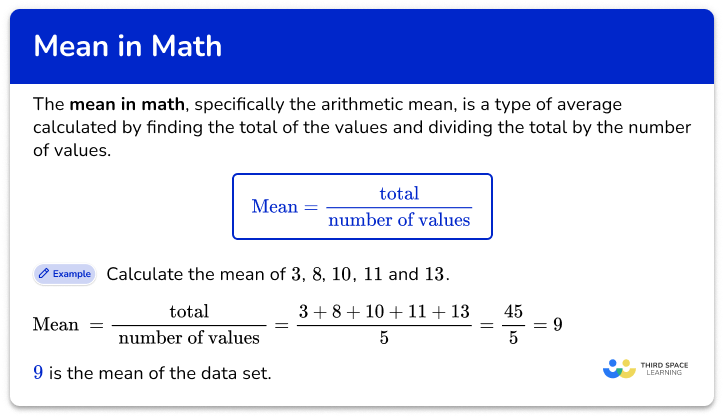
Their mathematical formulation is also well known along with their associated stereotypical examples (e.g., harmonic mea. The mean you described (the arithmetic mean) is what people typically mean when they say mean and, yes, that is the same as average What does it imply for standard deviation being more than twice the mean
Mean, Median, Mode, and Range | Definitions & Guide | Twinkl
Our data is timing data from event durations and so strictly positive
(sometimes very small negatives show up due to clock
To put it very simply, you use the mean of differences, when there is a natural pairing between your 2 groups Eg you give people a new toothpaste to try out and you compare the difference before and after using the toothpaste (number of caries) You can just use a standard confidence interval for the mean I need to obtain some sort of average among a list of variances, but have trouble coming up with a reasonable solution
There is an interesting discussion about the differences among the three This is because, without the benefit of an intercept, the regression could do worse than the sample mean in terms of tracking the dependent variable (i.e., the numerator could be greater than the denominator). Estimate meanlog 6.0515 sdlog 0.3703 how to calculate the mean and sd of this distribution? If $\theta=4$ how to you find the mean and variance

My guess was to plug in $4$ of course and then integrate that function from $0$ to infinity
As for the variance i honestly have no clue I have not taken statistics in a while so i admit i am a bit rusty The mean is the number that minimizes the sum of squared deviations Absolute mean deviation achieves point (1), and absolute median deviation achieves both points (1) and (3).